Showing posts with label Art. Show all posts

Saturday, July 31, 2010

Vermeer


There was a time when I found Dutch art completely uninteresting. After connecting some of the historical dots between hermeticism and the art of the European Renaissance, my view changed. And just after that I fell in love with the work of Johannes Vermeer.

The symbols Vermeer's work are the things that get me. His work reminds me of hieroglyphics or ancient Christian icon painting, except with more dimension and detail. I like that he incorporates lutes and other kinds of stringed instruments that allude to love, poetry and the creative muse. I appreciate the windows that have the eight-pointed stars making reference to the light that comes from knowledge as well as the throne-like chairs ornamented with lion’s heads because they seem to speak of Sekhmet, neter of wisdom. I find it intriguing that he used the camera obscura to add precision to his work. And I adore the periodic appearance of that electric, azure blue.

Much of the reason Vermeer gets my respect is because of how he advanced some of the messages of antiquity into his own time, place and culture. To me he is a wonderful example of the way that Old Europe was not the cultural bunker that many people of today imagine it to be. It was and remains a place of cultural transfer. A crossroads in a most magnificent sense. A place where domestic and imported ideas, philosophies and dreams flowered and converged. Like so many other parts of the world, Spain and Portugal were places where there was an amazing overlapping of traditions—Moor, Christian, Jew and so many others. This coming together laid the foundation for the Spanish Golden Age. This time of Spain being on top, of course, led to various colonization campaigns. One place they colonized was Vermeer’s native land, now called the Netherlands. And then eventually there came a Dutch Golden Age which came just on the heels of the Dutch ousting their former Spanish colonizers. It seems that a lot was channeled in to the Netherlands through Spain (as earlier much had been channeled into the Iberian peninsula from elsewhere) especially when it came to art and science.

Though I also like The Astronomer, Christ in the House of Martha and Mary as well as The Geographer, Woman Holding a Balance is probably my favorite Jan Vermeer painting. I like it because of the way that it connects to the ancient Egyptian concept of Ma’at.

In Woman Holding a Balance, the central figure is a pregnant woman of apparent material means. Hanging on the wall to the woman’s right is a painting of the Last Judgment, the descending figure of the Savior illuminated in a ball of light. The light in this Last Judgment painting is similar to the light that comes from a window above the woman’s own head. In this woman’s right hand is a small scale. Her delicate left hand rests on a table in front of her large belly. On this table she has emptied the contents of a jewelry box and unbundled a bolt of cobalt blue cloth. On the wall directly in front of this woman is a mirror and just above that mirror is a window that lets the subtle glow of daylight into the shadowed room. Underneath her blue coat with its fur that seems to allude to clouds, the woman’s dress is the same saffron-gold color as the sun. The woman does not look in the mirror. It is not hard to imagine this woman silently reciting some version of the 42 Declarations of Innocence as she keeps her gaze fixed intently, yet gently on leveling her scale.

In visual art as well as literature, no symbol goes to waste. The artist includes everything for a reason. So, it seems that this main figure reminds the viewer that each must stand in front of the mirror of her soul in an act of self reflection. In every life there must be a personal day of reckoning. To know God, we must heed the advice of the ancients and know ourselves before we can expect to bring anything meaningful into being.

I like the story this artist tells about how she used Vermeer's painting as a reminder of the need to balance material with spiritual as well as the hauntingly beautiful film, Girl with a Pearl Earring.


Want more? Check out these links:


Essential Vermeer


Ma'at


Metropolitan Museum Islamic Art and Geometric Design

Sunday, November 29, 2009

Each One Teach One

Dancer Junaid Jemal Sendi (Ethiopia) 2004/2005 protégé of Saburo Teshigawara (Japan)

Today I learned of the Rolex Mentor & Protégé Arts Initiative award that connects creative people of many genres. Masters like playwright Wole Soyinka, opera diva Jessye Norman, musician Youssou Ndour, novelist Toni Morrison and many others from all over the world passing along their memory, vision, technique and encouragement to a new generation is exciting, not to mention necessary.

How amazing it would be if there were to be a kind of structured linking of everyday grandparents, old guard community artists/activists, retired professionals with younger members of their tribe. Imagine!

In the meantime, check out this video of Morrison interacting with her protégée, Julia Leigh of Australia.

Sunday, October 25, 2009

No Such Thing As a Still Life


I walk in harmony, heaven in one hand, earth in the other. I am the knot where the two worlds meet. "The Knot of Isis" from Awakening Osiris

I once heard a scholar named Beatriz Morales, when speaking on the Abakua of Cuba, say that her devotion to scholarship was not motivated by a desire to accumulate knowledge. Her probing, traveling, lecturing, documenting and the like were more a kind of spiritual practice. Morales is one of the only people I have ever heard to say this outright. And though I'd never made that exact connection between scholarship and spiritual practice, I'd say that in many ways the same is true for me.

Rummaging around in my books and papers, I recently rescued notes from a talk given by filmmaker/writer/scholar Trinh T. Minh-ha at Agnes Scott College back on September 27, 2007. At that time, I was still a (mostly) stay-at-home mother doing all that needed to be done to tend to the needs of my new baby and my new self, a self that had changed in some extremely uncomfortable ways. To make myself feel connected, I'd done number of things including start this blog, get involved with some online communities and sign up for newsletters.

One social connection that I plugged in to was Agnes Scott College's events calendar. They often brought in prominent artists and, even better for my SAHM budget, many of these events were free (Sandra Cisneros and Nawal el Saadawi were two that I had previously seen courtesy of ASC). The Trinh T. Minh-ha event was one of several that stood out on the calendar. I recognized her name from bell hooks’ Sisters of the Yam which I'd read back during the end of undergrad when I was living what I think of as my Magical Maiden phase of life-- mind expanding, blooming, curling tendril like in every direction it could fathom. Deciding to go to the talk was, in some bizarre way, like me trying to get in closer touch with an old self who completely believed in the power of art, beauty and culture to transform the individual and the community.

I prepared for the event kind of like others might preparing for a day trip, mindful to pack dinner for Jared and a snack for myself. I also bathed my baby (ignoring protests of having him out in the "night air") and dressed him comfortably in his pajamas, which my mother advised I do whenever I thought I might be out late, which these days meant past about 7 or 8 p.m.

I honestly had no idea whether my somewhat unpredictable little Jared would sleep or stay awake. If he stayed awake I didn't know how kindly he'd take to the two of us sitting still. Why didn't I get a babysitter? Likely, I couldn't find one. Despite the fact that Jared was born into a fairly large African family, they rarely volunteered. This made me often seek the help of a teenager who lived a couple of doors down from us. I would call on her when I really needed an extra pair of hands, had the money and when her schedule would permit. This was probably one of those times when she was studying or had volleyball practice or something. Part of me considered canceling my plans while the other (satisfied as she was with the blessing of getting time to spend and bond with her baby) stubbornly refused insisting that she was bound and determined to get some air-- city air!

I had become the poor soul so outing-deprived that she’d take her wailing or chattering baby to a movie or concert, trying her best to ignore it as others cast her dirty looks living, as I did, out in the burbs with Jared's father/my in-laws. For one reason or another it was hard to make face-to-face or telephone contact with friends. Though I did get out of the house it was usually to grocery or clothing shop for the baby, both things that I enjoy but both of which can also get old. And quick. Often, the baby and I would go for walks around the neighborhood, and we had begun hunting for good neighborhood parks. Sometimes I'd make a big deal out of taking us to the Fiesta Mall on Buford Highway hoping to catch one of those parking lot carnivals, a mariachi band or simply soak up the festive atmosphere.

What all of this amounted to was that I often felt seriously isolated and sought ways to do something about it. So, I took my chances as well as the advice I'd heard passed down from so many artist-academic elder mamas: wrap your baby on your back and tend to your business as women of color have done for ages. You serve as an example when you love, support and nurture your interests right alongside those of your child. (As it turned out, the baby fell asleep in car and ended up sleeping soundly in his stroller as I wheeled him across campus and to the auditorium. He slept through the talk and woke up, as if on cue, exactly at the end.)

After all of the effort it took to get there, I admit to initially being underwhelmed by the presentation. Trinh was not a dynamic presenter like, say, Robert Farris Thompson. He's such a showman that few can compare, so I don't think that that is what I expected. But I did come in search of a particular thing. Don't ask what. An anecdote or candid reflections on artistic process, maybe. No dice. Her manner was formal, and she read from carefully prepared notes that outlined complicated ideas that had me contemplating easing out of the door within the first ten or fifteen minutes of arrival. As is often the case, I wasn't in much of a mood to translate dense, lofty Academese. (Completely nonsensical seeing as how I was at a talk given by a scholar on a college campus, I know. Maybe I thought that her presentation would pitch a tent somewhere between the lands of Artist and Intellectual.) I also admit to being a little taken aback by what sounded to me like dismissal of a metaphor or image that is dear to me: that of earth as mother and giver.
What ended up being really cool and made the event well worth the effort was that once I really settled in and held my mind steadily in the moment, what Trinh had to say became more profound and absorbing, something like the gradual breaking of day. I found that she does belong to the sisterhood whose work blurs the line between what we know of the mind and what we know of the soul. I needed simply to be still to receive or witness what she was working up to.

She spoke about light and movement as they relate to her film Night Passage, film inspired by Kenji Miyazawa's late 1920s novel Night Train to the Stars as well as, she acknowledged, Antoine Saint Exupéry's The Little Prince. We humans lie somewhere between the machine world and the spiritual world, she said, and we live in a time when the crossing of boundaries of land and sea is so much a part of what we do. This kind of traveling is important yet should not be seen as more important thatn paying attention to what's going on in the space in which we're standing. We must take the time to "traverse the snare of illusion," or simply look at ourselves and at life in such a way that we can sort out what is real, and I would add, worth our attention. So much that we think is important is not; what remains here after we have traveled on is that which is intangible. She said that Night Passage speaks most importantly to the idea of time and asks questions: In the flash of emergence and vanishing, what will you put in the story space of your life? What will your pose be?


This tied in to her speaking about the dance of opposites and it being best to use opposing forces as complements to one another. She echoed a thought put forth by the Dalai Lama in his talk "Spirituality and Nature" when she eloquently cautioned that science without conscience does no good and that technology without poetry does little to empower. She named the middle, the place of neither extreme, as the true place of freedom. There was talk of music, which made sense being that it is essentially the child of light and time. (I later learned that she was originally trained as a music composer and taught at the National Conservatory of Senegal.) She gave something of an affirmative nod to notions of sound healing held by dancers, musicians, metaphysicists and even some hard-nosed acoustic scientists when she went on to speak about the importance of sound vibration, mentioning that the body that is out of sync takes a while to attune to its instinctive bio-rhythms.

Trinh spoke about the slow but steady "speed of the flowering mind" and called attention to the notion that, philosophically speaking, there is "no such thing as a still life" in Asian art. Life is always moving and changing, and if we sit still and mindfully observe it for long enough we see that even a mountain changes-- be it in the plant life that grows upon it, the animals that graze upon it and so on.

I took away from the talk what was useful to me and found that like so many teachers connected to ancient Eastern traditions, her very manner of presentation reminded me of something important: being fully present allows us to perceive the life that vibrates within us, through us, all around us at all times.

~*~*~*~*~*~*~*~*~*~*~*~*~*~*~*~*~*~*~*~*~*~*~*~*~*~*~*~*~*
Abakua URL: AfroPop Worldwide "Voice of the Leopard: Ivor Miller talks to Ned Sublette"

Dance images depict traditional Balinese and Indian Bharatanatyam dance. For more on Indian story dance, see the 74 minute India Blooms: Stories in Motion , a program of the Chicago Opera Theatre.

Saturday, August 22, 2009

Dawn's Messenger

There are lots of books by my bedside. A little bookshelf to the right of the bed, and in front of that another stack for me. Then a stack for the little one. Happy Baby Things That Go. First the Egg. Earth Mother. Creation-My Father Loves Me. The Fortune Tellers. Look and Learn ABC. I must admit that having a book jones is both a blessing and a nuisance. If I'm not careful, I'll trip over them when I get up to go to the bathroom at night.

Fortunately, most of the books around here are ones we own. A few, though, are from the library. Any time I go there to drop off old books, I say that I'm not going to get any new ones. Not only am I trying to control this passion, but I'm also notorious for racking up fines since it's never easy for me to return good music or reads.

Of course, I always do end up getting something, swearing to self that I will turn it in by the due date. Art books, with their big pages and color plates, are especially luscious treats. One art book I recently checked out is Romare Bearden: The Caribbean Dimension. Back during college, professor Floyd Newsum's survey of African American art introduced me to Bearden's work. Bearden, Aaron Douglas and Lois Mailou Jones were some of my first favorites.

This look into Bearden's life on St. Martin has a subtle but sure hold on me because of the roots culture and spiritual element that is strongly present in the work. The authors-- Sally and Richard Price, who have also written books on the maroons of Suriname, hence their draw to this phase of Bearden's creative cycle-- allude to the "natural mystic" but (so far) don't refer to Bearden's embrace of African notion of spirituality outright.
Such a holy communion there is between Bearden and nature, especially as nature reveals itself in the Caribbean. There is a breathtaking passage where Bearden gives an earth-reverant and hermetic description of sunrise at his home in French St. Martin. Imagine:

Just as it becomes light, a large black bird soars into view. Sometimes called the "hurricane" or "weather" bird by the people on the island, this frigate bird, with its wingspan of about six feet, glides effortlessly, a master of rising and falling...currents. The coming of the weather bird heralds the dawn. There comes a charging wind that this fine bird uses in his swift climbing spirals, and the dark purple, now graying clouds of night begin to take on new colors and the sun mounts. The clouds become saffron, then vermillion and many shades of red, especially a deep cardinal. Undoubtedly, the sun is the emperor. Observing this vast elemental change, I can readily understand how people worshipped the sun in ancient times.


Image: Romare Bearden, In a Green Shade (1984)

Wednesday, November 26, 2008

Peace

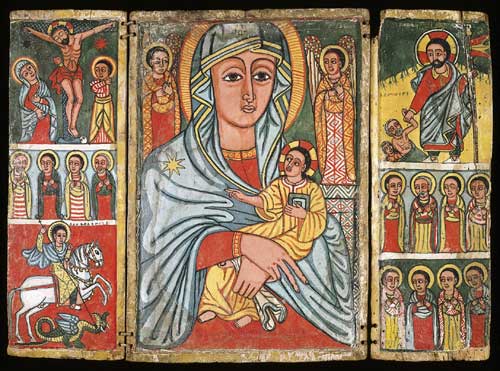
"Icon: Ethiopian Orthodox Style, c. 1750-1855" from Ethiopian Icons: Faith and Science online exhibition at the
National Museum of African Art.

l
Joy to the world.
May peace shine within you, be upon you.
Shalom. Salaam. Salem.
Amen.
l

Sunday, August 03, 2008

Writing Residency

As Ms. Celie would say, I’m here. Nervous about my decision, but I'm here: I made it to my first two-week residency for my Master of Fine Arts Program. I’m doing it.

There was a tremendous amount of preparation that went into my being able to come. I got a reprieve from some of my frenzied thinking when I arrived on campus (the frienzied thinking was replaced with an intense class schedule). I found the school to be as much a nature preserve as it is a place of higher education. The campus has trails and when walking along them you come across crows and cardinals, wolves and deer, owls and even a horse or two. A tire swing hangs from one of the walnut trees. Cicadas sound off at night.

One of my classmates joked that she was underwhelmed when she drove onto the grounds. I laughed, because it's true. Our school is understated. It whispers rather than shouts, being especially quiet since we distance learning/low res students, a skeletal admin staff, some construction workers and summer camp counselors and kids are among the only ones on campus. Just beyond the gates is a mall, many retail and grocery stores, a shopping village and the highway. But our school is kind of a world unto itself.

On the side of my dormitory, called the “T,” the resident students are cultivating a garden. Some of the things I recognize are oregano, rosemary, basil, onions, collard greens and kale. There is a scarecrow standing guard; the scarecrow is angular and thin, looking more like the resting sail of a boat than it does anything else. Many of the dishes that the kitchen staff prepare for our meals make use of some of these fresh herbs. Some people complain about the food, but I'm overall pleased with it. The cooks prepare many healthful quasi-gourmet dishes, many of them vegetarian. They always have herb teas and fresh fruit in addition to the standard soda and sweet treat desserts.

As for the buildings, the facades are uniform (great stress is put on uniformity) featuring a type of stone work that I saw used on a number of other homes when I was riding one of the MTA buses through Baltimore. The buildings seem to be inspired by a Frank Lloyd Wright's Fallingwater along with a Natural Home Magazine kind of aesthetic because of their sleek interior design combined with an eco-conscious elegance. The buildings make excellent use of natural light and feel comfortable and inviting. The seem like an extension, rather than a terrible intrusion on, the natural environment that surrounds.

It's a good place to re-charge and prepare for what lies ahead.

Sunday, April 27, 2008

One Thing Leading to Another

"She gathered All before her/And She made for Them a sign to see..."


Recently, rather than do my class prep work at my job, I decided to do it at the library close to my son's babysitter's house as a change of scene. Given as I am to diversions and daydreaming, I cruised through the periodicals section to see if this particular Dekalb county library subscribed to any cool specialty publications, especially since many of their patrons are East African, Eastern European and South Asian refugees in addition to there being large Caribbean and black southern communities. Even if I didn't happen upon any such literary delicacies, perhaps some of the garden variety American glamor or lifestyle magazines had features worth sampling. (As you've surely figured out by now, I had basically decided to treat myself to a little goof-off time.)

Once I finished scouring the shelves, I settled into an armchair next to a sunny bay window opposite an Ethiopian school boy engrossed in a book on Mars. I had, I'd say, half a dozen pop and ethnic magazines stacked at my feet having pretty much given up any pretense of preparing for class. With the help of my school book French, I haltingly made way through a francophone African magazine to find, not surprisingly, that there's international fascination with Obama. I also learned of the dismissal of Manuela Ramin Osmundsen, Norway's first black cabinet member; found out about a few new musicians and got the scoop on old vets like Youssou N'Dour and Manu Dibango.

After this I switched gears to African American mags, reading up New York's new governor, David Alexander Patterson; Nicole Mitchell's Xenogenesis Suite, the flutist's tribute to Octavia Butler; and Vanessa Williams-- someone whose resilience I've long admired-- being really frank about divorce, family, career, health, aging. For the latter, her weapons were a touch of botox blended with yoga. Though I found it funny, I ain't gonna begrudge the sister for being honest with her stuff. (Kudos to Melanie Johnson Rice; she's doing a wonderful job of of upholding the legacy entrusted to her by her father, both appealing to its traditional audience and broadening its scope by including points of international interest.)

Of biggest interest was one of the cultural magazines which featured an extensive listing of exhibits around the world. A few that caught my eye were Inscribing Meaning: Writing + Graphic Systems in African Art, Art of Being Tuareg: Sahara Nomads in a Modern World, and Pharaohs, Queens and Goddesses . Going on a virtual tour of these exhibits led me to the Jewish feminist Judy Chicago's majestic installation The Dinner Party and this passage:

And She gathered All before Her
And She made for Them a sign to see
And lo They saw a vision
From this day forth
Like to like in All things
And then all that divided Them merged
And then Everywhere was Eden once again

I love that these powerful words tell of how those who submit to inner vision--healers/artists of various stripes-- are in prime position to be harbingers of a better day.

Not only does it turn out that the Dinner Party could add a lovely dimension to a project that I'm working on, but I found the above incantation to be an ensouling baptism (Ensouling! What a word. Kind of like inspiring. "Only soooo much better than that!" To borrow a soundbite from Reese Witherspoon and Legally Blonde ;D )

Chicago's words strike the same chords as does the rememberance of Isis' mythical journey to gather the scattered pieces of her Beloved to make him whole again. The women Alice Walker writes about in The Temple of My Familiar and Possessing the Secret of Joy. Ntozake Shange's reminder in Sassafrass, Cypress and Indigo that "Creation is everything you do. Make something!" The healing and circle of sisters (Yam, Corn, Rice and Plantain sisters sending telepathic calls to one another, party line style) that Toni Cade Bambara writes of in The Salteaters. And finally, Julia Cameron urging in the Artist's Way to bear in mind that it's not up to the maker of the work to stand in judgement of said work. The maker's job is simply to be sincere, devoted and diligent in what (s)he does and once the job is done, share the harvest.

Tuesday, March 18, 2008

Sunday at the Met

Check out this link to part of the Metropolitan Museum's transcribed lecture series; this one takes a look at Christianity's First Centuries in Africa and features work from one of my favorite photographers, Chester Higgins.


Ethiopian child with Meskel Flowers from
http://www.globalgang.org.uk/images/resized_image_tcm7-26114.jpg

Tuesday, August 14, 2007

Imago


An imago is a very deeply charged image. An image becomes an imago when it activates an archetypal energy field and thereby touches on not just this present occasion but activates our whole history as well. ~Curlee Raven Holton, artist & professor

Looking up the varying definitions of "imago," I found that most references relate the term to the development of insects or, on the opposite end, an idealized vision that one may hold of a parent. Beats me what common ground lies between these two, but whatever.

Many months back, I saw the Curlee Raven quote at an art exhibition that featured the work of a woman named Robin Holder. The idea had a pull that called me to jot it down, yet it took me until today-- as I went about arranging baby's toys and clothes and weeding through the tons of paper I tend to accumulate (usually always with the intention of sharing) to frame it with these gathered thoughts. I'm taking this moment while baby boy naps on the floor nearby to put it here, where it belongs, hoping that some of you friends will think to yourselves and talk to me and one another about the images that really mean something to you.

There are a number of visual artists that I feel are crafting important and beautiful work of the sort that Professor Raven speaks of. Sankofa kind of work that embodies clear knowledge of history and which also gleams with faith in and hope for the future. This kind of work is intimately connected the expanse of heaven and the deep recesses of earth by a starry bridge called dreams. Natural dreams that descend upon clean minds and open souls...

The best Haitian art has this kind of spirit. Renee Stout with her clever Madame Ching and Fatima Mayfield personas, too. Whitfield Lovell is also coming to mind, as are the departed John Biggers and Minnie Evans, Faith Ringgold and Bettye Saar. And then, I'm thinking of a recent issue of the International Review of African American Art; it featured the collection of Samella Lewis. Thumbing through those pages and being reminded of the aesthetics of some of the art from thirty, forty or more years ago...wow!

Surely there are many more that I could mention. But since Little Mr. Son-shine is taking his after-breakfast nap and I've yet to get showered and dressed for the day, I'd best get on and use my time wisely.

Catch you in another post.

Thursday, October 12, 2006

Sarava, Old New Orleans


The memory of things gone is important... Things like old folks singing in the moonlight in the back yard on a hot night or something said long ago. --Louis Armstrong

...and a few word sketches, "old-time stories," in which some of the heart & spirit of the place is preserved:

The Goodness of St. Rocque and Other Stories by Alice Dunbar Nelson (my fav is "The Praline Woman")

He's The Prettiest: A Tribute To Big Chief Allison "Tootie" Montana's 50 Years Of Mardi Gras Indian Suiting (be sure to scroll down and see the pics)